


Research and Training: Prof. Peace Mamle Tetteh
This training was organized as part of the preparatory activities for the study titled Prevalence and Predictors of Sexual Risk Behaviors in Ghanaian Adolescent Girls: Insights from Mother–Daughter Perspectives.
The primary objective of the training was to equip research assistants with the ethical, methodological, and contextual knowledge required to conduct high-quality and ethically sound data collection among adolescent girls and their caregivers.
Given the sensitive nature of the study, particularly its focus on sexual risk behaviors, parent–child dynamics, and adolescent well-being, the training emphasized research ethics, rapport building, cultural sensitivity, and best practices for engaging children and adolescents in both quantitative and qualitative research.
Grant: $50,000
Departmental Training for Institutions
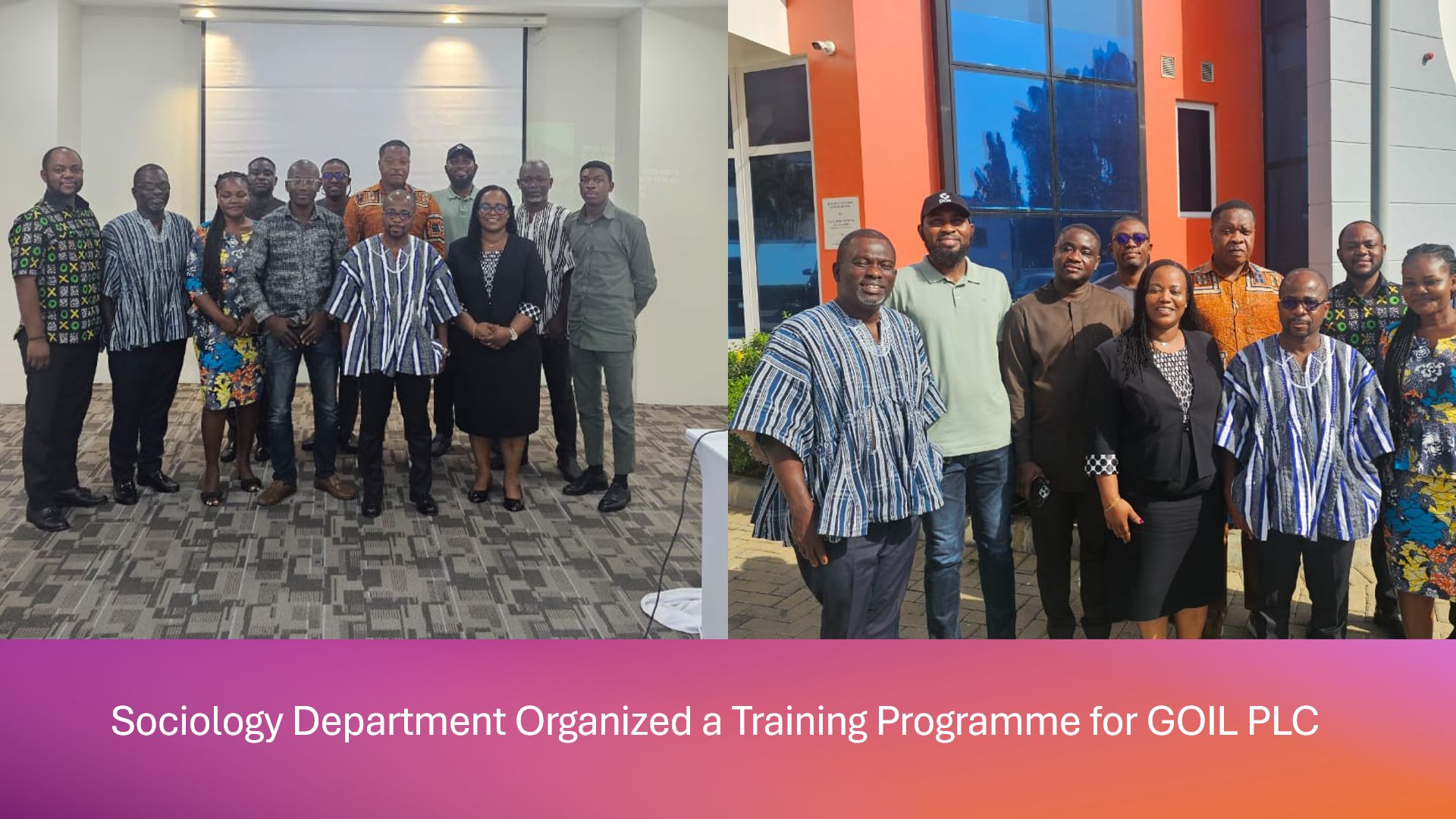 A one-day refresher and capacity- building training session for officers of the Research and Business Intelligence Department of GOIL PLC was successfully held at the premises of the Ghana Employers' Association.
Sylvia Esther Gyan

Conference Presentation
British Sociological Association Annual Conference
"Transforming Adolescents with Disabilities Access to Sexual and Reproductive Health Information from AI-enabled Chatbots" Globally, adolescents access sexual and reproductive health information from various sources including the Internet and the web. These sources offer adolescents confidential and convenient access to relevant information. However, adolescents with visual, hearing, and speech disabilities living in low- and middle-income countries (LMICs) face many barriers in gaining access to sexual and reproductive health (SRH) information, regardless of the source. While artificial intelligence (AI) has proven to increase access to information on virtually any issue of human interest, not all content generated by AI may be culturally appropriate depending on respective socio-cultural contexts and policies. In this paper, we highlight some challenges that adolescents may encounter in their quest for information relying on existing AI platforms. Using the participatory research approach, we engaged relevant stakeholders from the Ghana Health Service (medical officers and health promotion officers) who work on adolescent sexual and reproductive health to vet 6591 questions and answer pairs on adolescent sexual and reproductive health generated from OpenAI’s ChatGPT and Google’s Gemini. Employing content analysis, our findings after the vetting indicated that 1,652 answers were modified, deleted, or expanded. It is recommended that efforts to design AI solutions in SRH and other issues in Africa, which require the use of LLMs, should be deliberate about localizing the data generated.
Utilizing Artificial Intelligence (AI) to Promote Sexual and Reproductive Health Outcomes for Adolescents with Disabilities in Ghana (Funded by IDRC through IDI)
Akosua Keseboa Darkwah

Grant Won, Hewlett Foundation grant
Solomon Kofi Amoah

Conference Presentation
UU-A Student Summit 2025 Symposium Series
Formal-informal linkages, agrarian transformation and labour casualisation: a case study of Ghana’s oil palm sector.
Rabiu K. B. Asante, Faculty Exchange Programme
Erasmus+ International Credit Mobility Programme Grant, University of Hradec Kralove, Czech Republic, Staff Mobility Programme

Isaac Toe Benjamin Agbanyo, Maureen B. Kusi, Rabiu K. B. Asante, Sylvia Esther Gyan

Conference Presentation
9th School of Social Sciences International Conference
From “Ghetto” to “Group Chat”: The Displacement of Physical Drug Markets by Digital Platforms Among Ghanaian Urban Youth
Across Africa, most substance use research focuses on peer pressure in physical spaces. Despite the rise and increasing use of social media among digital natives, the social media platforms they use as sources of influence and access to substances have received less attention. This paper explores how encrypted and visual performative social media applications play different roles in normalising and accessing substances. Survey data was collected from 2455 residential tertiary students using a cluster sample method across a large public university on their substance use and social media behaviour. A combination of chi-square tests and multinomial logistic regression was used to determine the means of access to substances and the types of substances used, as well as to identify which type of social media application predicts drug-use behaviour. The results show that exposure to social media application use significantly predicted substance use (OR = 3.23, p < .001). Additionally, social media application use exposure was a strong and statistically significant predictor of substance use. Each unit increase in social media application use exposure tripled the likelihood (odds) of reporting any substance use (b = 1.17, SE = .18, p < .001, OR = 3.23). Relying on algorithmic risk influence this paper argues that the nature of the social media applications used plays different roles in substance use.