UG Nkabom and McGill University Collaborative Session Highlights Avenues for Youth in Sustainable Agriculture and Nanotechnology
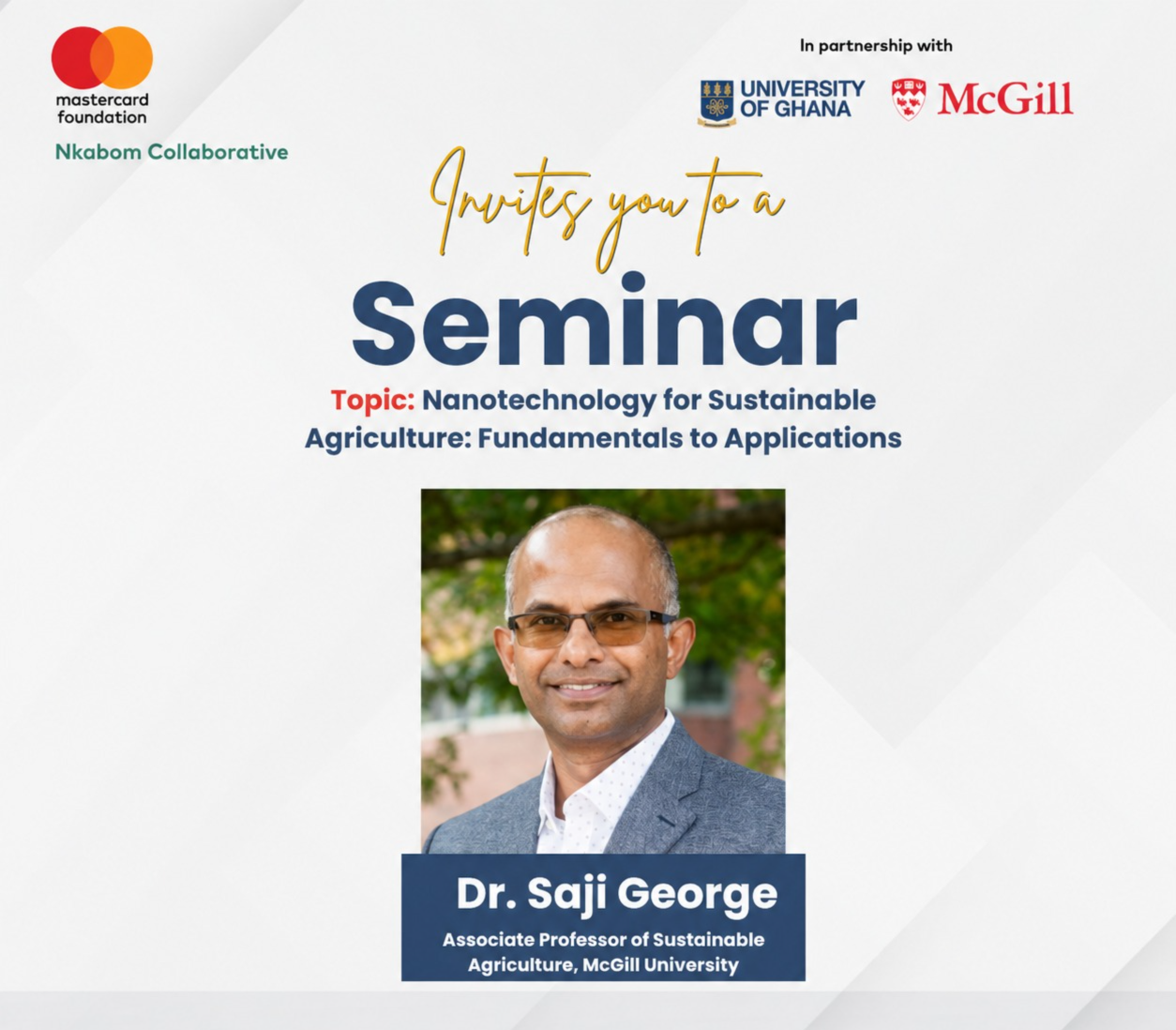
Nkabom Collaborative at the University of Ghana, in partnership with McGill University, has engaged faculty and students on emerging opportunities in nanotechnology and sustainable agriculture, with a focus on creating pathways for young researchers to pursue research, training and international collaboration.
The seminar, held under the theme, “Nanotechnology for Sustainable Agriculture: Fundamentals to Applications,” featured Dr Saji George, Chair and Associate Professor in the Department of Food Science and Agricultural Chemistry at McGill University and Canada Research Chair in Sustainable Nanotechnology for Food and Agriculture.
Held at the School of Public Health, the session brought together faculty and students to explore how nanotechnology can be applied to address challenges in plant and animal agriculture while advancing food safety, food security and agricultural resilience.
Dr George shared research from his group on nano-enabled antibacterial combination therapies designed to combat persistent and antimicrobial-resistant infections in livestock, as well as nano-enabled biostimulants that enhance crop growth, resilience and protection.
He also highlighted the importance of developing greener approaches to nanomaterial synthesis and identifying low-cost, naturally derived nanomaterials that can be scaled for agricultural applications. He stressed that technological interventions in the agri-food sector must respond to economic, environmental and societal considerations to achieve long-term sustainability.
The engagement also provided an opportunity for students and young researchers to gain exposure to cutting-edge research and learn about potential opportunities for further training, student exchange and research collaboration.
Moderator of the session and Lead for the Education Pillar of UG Nkabom, Dr Hayford Ayerakwa, said the engagement was designed to expose faculty and students to emerging research while identifying areas where the University of Ghana and McGill University could collaborate.
“The session was put together for faculty and students to learn what is going on and see what opportunities for collaboration we could pursue. It was exciting and we look forward to seeing future collaborations and projects emerge from this engagement,” Dr Ayerakwa said.
He noted that the discussions were particularly relevant to students and young researchers seeking opportunities to broaden their academic and professional horizons.
Dr Ayerakwa said the collaboration could create opportunities for student exchanges, access to courses and scholarships, as well as further training and co-supervision.
“We are also interested in seeing opportunities for our students. There are student exchange opportunities between McGill and the University of Ghana and we are looking at some of the available courses and scholarships. More importantly, we look forward to exposing our students to these opportunities so they can consider them as options for further training,” he said.
He said such engagements reflect the broader vision of UG Nkabom to build meaningful connections between the University community and international partners while creating opportunities for young people to participate in global research and innovation.
The session further underscored the importance of equipping the next generation of African researchers, scientists and agricultural innovators with the knowledge, skills and networks needed to contribute to sustainable solutions to challenges in food and agriculture.
Dr George’s research focuses on enabling the transition towards a bioeconomy in agriculture. His research group works on identifying and characterising bacteria with biostimulant and biocontrol potential, optimising fermentation processes and developing methods to stabilise bacterial preparations for use in crop production.
His wider research examines the relationship between nanomaterial properties and their beneficial or hazardous biological outcomes, with the goal of developing sustainable nanotechnology applications for food safety and agricultural development.
Dr George has authored more than 100 peer-reviewed articles, holds five patents and has delivered more than 100 invited talks. His teaching and research contributions have received international recognition, including a Canada Research Chair (Tier 2), visiting professorships at IIT Madras and GADVASU, Punjab, and the VAIBHAV Fellowship from the Government of India.
The seminar concluded with an interactive faculty and student engagement session focused on potential areas for collaborative research, student exchange and co-supervision.
Through initiatives such as this, the UG Nkabom Collaborative continues to strengthen partnerships that connect research, education and innovation while creating avenues for students and young researchers to learn, collaborate and contribute to solutions for Africa’s development challenges.