Rethinking Forced Displacement in Africa: IDRC Research Chair and MIASA convene international conference in Senegal
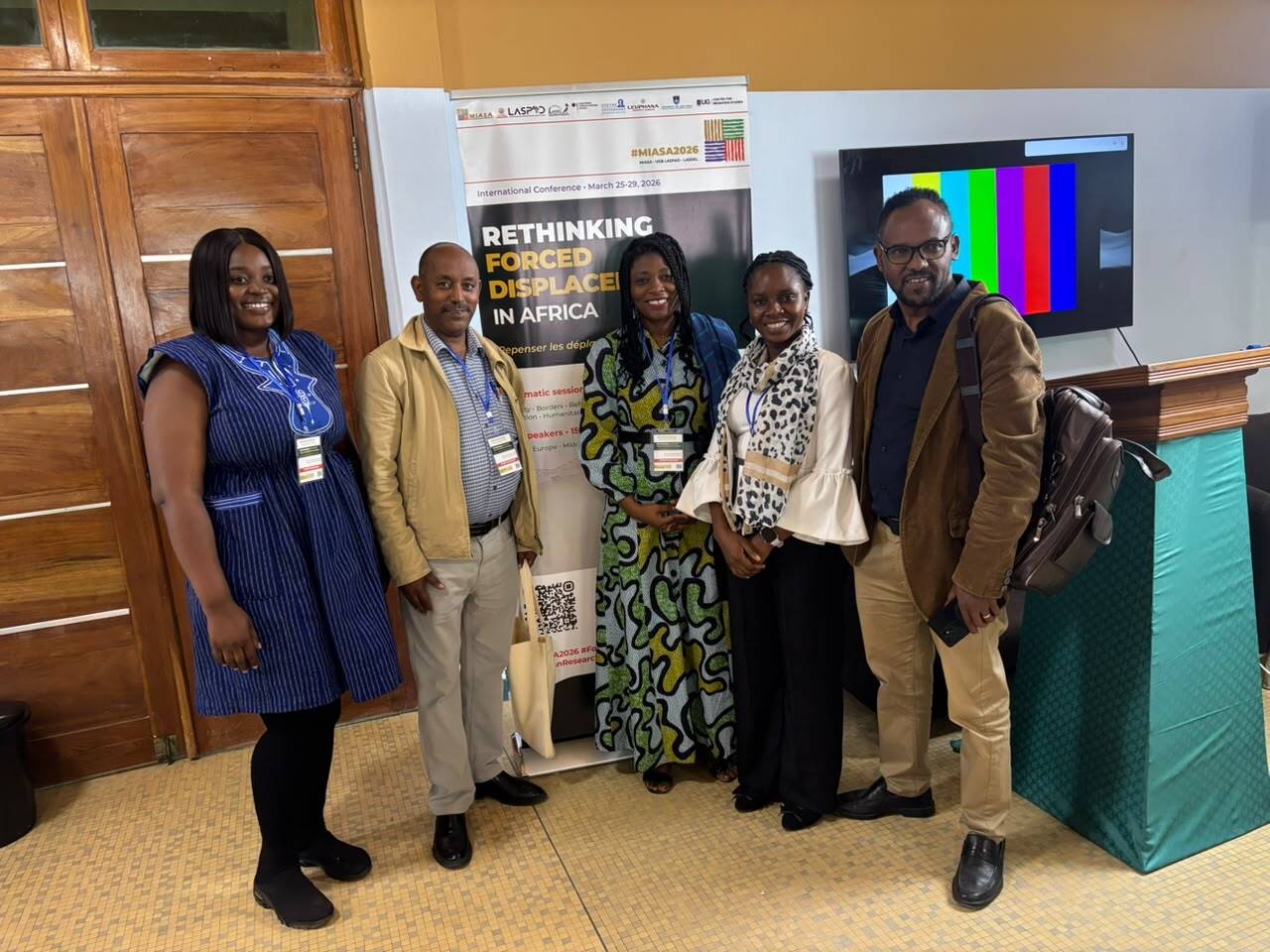
The International Development Research Centre (IDRC) Research Chair on Forced Displacement in Anglophone West Africa at the University of Ghana, led by Prof. Mary B. Setrana, in collaboration with the Merian Institute for Advanced Studies in Africa (MIASA) and other academic partners, convened an international conference on forced displacement in Africa from 26 to 28 March 2026 in Saint-Louis, Senegal.
Held under the theme “Rethinking Forced Displacement in Africa”, the three-day conference brought together scholars, researchers and practitioners from across Africa and beyond to examine emerging and complex forms of forced displacement and their implications for African societies. The conference took place at the Laboratory for the Analysis of Societies and Powers / Africa-Diasporas (LASPAD) at the University Gaston Berger in Saint-Louis and was organised within the framework of the MIASA Outreach Programme.
The conference was hosted by LASPAD in collaboration with the Laboratory for Studies and Research on Social Dynamics and Local Development (LASDEL) in Niamey, Niger, and Goethe University Frankfurt, Germany. It provided a multidisciplinary platform for examining displacement processes, mobility, governance, humanitarian responses and the changing social realities associated with forced displacement across the continent, with particular attention to the Sahel and other fragile contexts.
The programme featured academic presentations, panel sessions and scholarly discussions that brought different perspectives to the study of forced displacement in Africa. Participants engaged with research and evidence on the relationship between forced displacement, mobility and migration, as well as the institutional and social processes that shape the experiences of displaced populations.
A major area of discussion focused on transitions between citizenship and refugee status, statelessness and related legal and institutional frameworks, including questions of access to basic social services. Presentations and panel discussions also examined intra-African mobility and immobility in situations of displacement, drawing attention to patterns of movement and integration within African regions.
Other sessions explored humanitarian protection and solidarity practices among displaced populations, including the roles of state and non-state actors and the ways displaced communities develop their own forms of solidarity, cohesion and coping in situations where formal humanitarian assistance may be limited.
The conference further examined Africa’s multifaceted border challenges, particularly how borders operate in contexts of insecurity and displacement. Discussions considered borders as spaces that can simultaneously facilitate or restrict movement while serving as sites of protection, refuge, economic activity and social interaction.
Prof. Mary B. Setrana, Research Chair on Forced Displacement and Director of the Centre for Migration Studies (CMS), University of Ghana, was among the conference conveners. Her participation built on the work of the IDRC Research Chair, which seeks to strengthen research capacity and generate evidence to inform policy and practice on forced displacement in Anglophone West Africa.
For the University of Ghana, the conference provided an important opportunity to strengthen collaboration between the IDRC Research Chair, MIASA and their network of African and international research partners. MIASA, based at the University of Ghana, facilitates interdisciplinary scholarship, research collaboration and intellectual exchange on issues of significance to African societies through its programmes and international partnerships.
The conference also afforded MIASA and the IDRC Research Chair opportunities to deepen existing relationships and establish new connections with researchers, institutions and practitioners working on migration and forced displacement. These engagements are expected to contribute to a stronger network for research collaboration, knowledge exchange and policy influence on forced displacement in Africa.
Through the presentations, panel sessions and informal scholarly engagements, participants exchanged research findings, identified areas for further collaboration and explored ways of strengthening the connection between research, policy and practice. The networking opportunities further positioned the University of Ghana and its partners to contribute to continental conversations and policy processes on forced displacement.
The conference placed African experiences and scholarship at the centre of discussions on forced displacement, recognising the diverse forms of displacement experienced across the continent and the need for responses that are informed by local realities. It also highlighted the importance of multidisciplinary and collaborative approaches to understanding the social, political and economic dimensions of displacement.
The three-day engagement in Saint-Louis therefore strengthened the visibility and collaborative networks of the IDRC Research Chair and MIASA while contributing to broader efforts to advance African scholarship on forced displacement. It reinforced the University of Ghana’s commitment to building partnerships that generate evidence, strengthen research capacity and support more responsive policy approaches to migration and forced displacement in Africa.