VC Prof. Nana Aba Appiah Amfo Showcases UG's AI Ecosystem at Warwick Distinguished Africa Lecture 2026
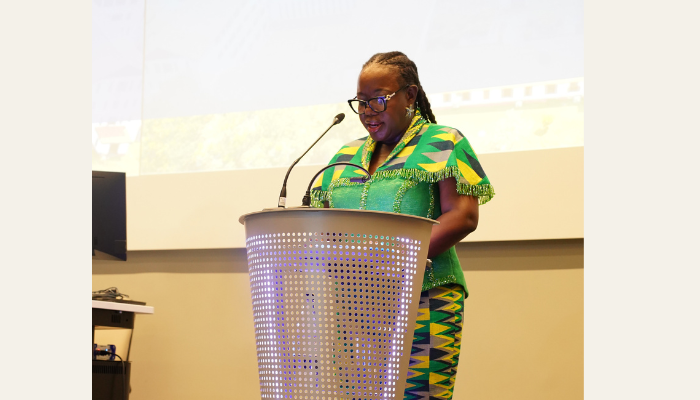
The University of Ghana is emerging as a leading hub for artificial intelligence innovation in Africa, with a growing portfolio of projects designed to address local challenges, promote inclusion and expand access to technology through indigenous languages.
This was highlighted by Vice-Chancellor Prof. Nana Aba Appiah Amfo during her lecture titled, ‘Whose Language Counts? African Voices, Knowledge Systems and the Future of AI,’ at the Warwick Distinguished Africa Lecture 2026, where she showcased the University's expanding AI ecosystem and its efforts to develop technologies grounded in Ghanaian realities.
At the centre of these innovations is 'Nana Aba AI', an artificial intelligence-powered assistant being developed by a team of University of Ghana students and recent graduates under the mentorship of Prof. Isaac Wiafe of the Department of Computer Science.
Designed to support prospective students, current students and staff, 'Nana Aba AI' provides information on admissions, academic programmes, university policies, courses and campus life. The system incorporates voice-to-voice interaction, allowing users to engage with the assistant through spoken conversations.
Prof. Amfo recounted a demonstration of the platform during which the system replicated her voice with remarkable accuracy when speaking English. However, she observed noticeable challenges when the AI encountered Ghanaian names and places.
“The issue was not the sophistication of the AI. The issue was the data,” she explained.
According to the Vice-Chancellor, the experience underscored a broader challenge facing AI development across Africa, the limited availability of digital resources and datasets in indigenous languages.
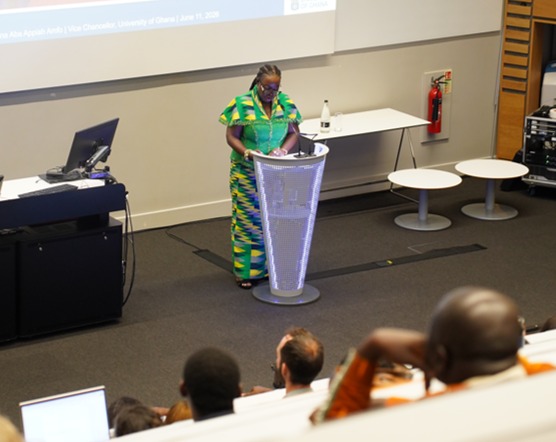
The project, she noted, illustrates both the immense potential of locally developed AI solutions and the urgent need to expand the collection and digitisation of African language data.
Beyond ‘Nana Aba AI’, the University of Ghana has established itself as a key player in AI research through the Human-Computer Interaction (HCI) Lab in the Department of Computer Science. Led by Prof. Isaac Wiafe and his team, the Lab focuses on inclusive technologies, multilingual computing, accessibility and human-centred AI systems.
One of its major achievements is the development of the UG Keyboard Suite, which supports eleven Ghanaian languages and enables the production of digital text in indigenous languages. Researchers have also developed spell-checking tools for Akan and Ewe, contributing to the growth of digital language resources.
She added that the University has further invested in foundational AI infrastructure through projects such as UGSpeechData, which has supported the collection of thousands of hours of transcribed speech data in languages including Akan, Ewe, Dagbani, Dagaare and Ikposo. These datasets, she acknowledged, are critical for the development of speech recognition, translation and other language technologies.
‘The University's AI innovations extend beyond language technologies into healthcare and accessibility,’ Prof. Amfo stated.
She further disclosed other initiatives such as the Ɔbaa Panin Chatbot Project, a conversational AI platform designed to improve maternal healthcare communication in Akan. The chatbot provides voice-based support using Ghana's Safe Motherhood Protocols and helps bridge language barriers in healthcare delivery.
“The Tɛkyerɛma Pa Project is another flagship initiative aimed at developing speech technologies for persons with speech impairments. Through partnerships with international collaborators, the project is leveraging AI to create more inclusive communication tools for individuals with conditions such as cerebral palsy, cleft palate and stammering,” she added.
The Vice-Chancellor added that UG researchers are also developing image-captioning systems in Akan and Ewe, voice description technologies and smart canes with voice interaction capabilities to support visually impaired users.
Prof. Amfo noted that these projects demonstrate how AI can be used to address real societal needs while preserving cultural identity and promoting inclusion.
“What is particularly significant is that these technologies are being developed within indigenous linguistic environments rather than assuming meaningful technological assistance must operate only through dominant global languages,” she said.
The University's AI agenda aligns with its strategic commitment to using a technology-driven and people-centred approach for development and supports Ghana's broader ambition to become a leader in artificial intelligence on the African continent.
Click on the link below to watch the recorded lecture
Photo Credit: Manuel Koranteng