UG, Austrian Embassy Chart New Path for Academic, Research and Cultural Cooperation

The University of Ghana and the Austrian Embassy in Ghana have committed to charting a new path for academic, research and cultural cooperation following strategic discussions between the Vice-Chancellor, Prof. Nana Aba Appiah Amfo and a high-level delegation from the Embassy led by its Ambassador, His Excellency Jürgen Heissel.
H.E. Heissel noted that Austria established its Embassy in Ghana only recently, in September 2024, marking a new phase in bilateral relations between the two countries.
He outlined potential areas of collaboration, including health sciences, agriculture, climate research, governance and digital innovation.
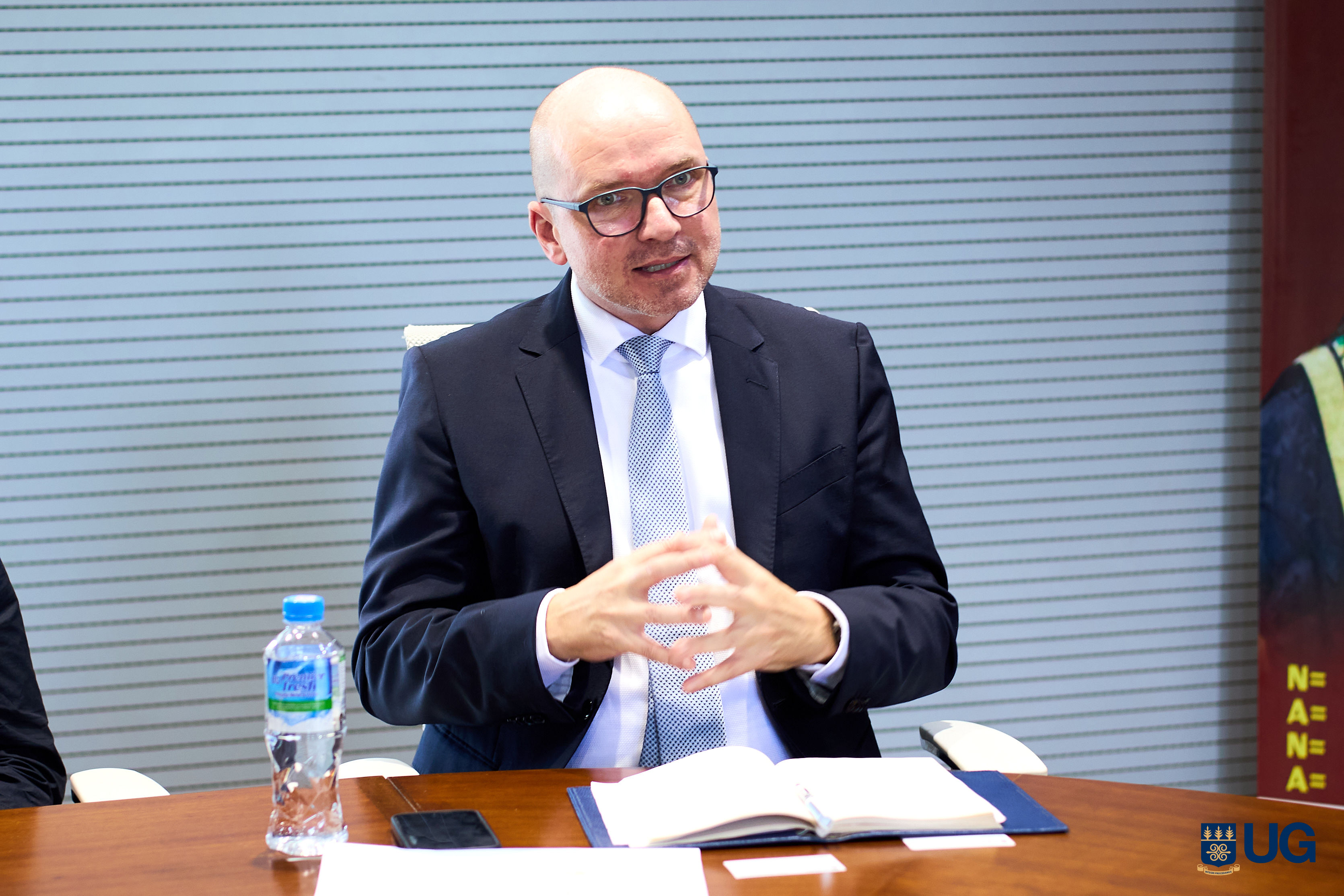
The Ambassador also highlighted European academic mobility frameworks such as Erasmus+ and the Africa-UniNet network, which support student and staff exchanges. He added that the recent establishment of visa services in Accra would improve access for Ghanaian applicants, noting that students and academics previously had to travel to Abuja for visa processing.
Welcoming the delegation, the Vice-Chancellor, Prof. Nana Aba Appiah Amfo, reaffirmed the University’s commitment to international partnerships, describing collaboration as central to the University’s vision of achieving global impact through innovative research, teaching and learning.
She further highlighted the University’s research agenda, which spans health, agriculture, climate change, governance, communication and digital transformation, including artificial intelligence and data science.

Prof. Amfo noted that existing partnerships with the Austrian Embassy should be deepened and better coordinated through structured engagement involving the University’s International Programmes Office and the Centre for European Studies to facilitate targeted collaboration and institutional linkages.
Registrar, Mrs. Emelia Agyei-Mensah, provided an overview of the University’s structure, explaining its collegiate system comprising the Colleges of Health Sciences, Humanities, Basic and Applied Sciences and Education. She noted that the system was designed to decentralise academic and administrative functions, improve efficiency and strengthen strategic leadership at the centre.

She added that the University has a student population exceeding 70,000, with campuses in Accra, Korle-Bu, Kumasi and Takoradi, as well as several distance learning centres nationwide. The Registrar also highlighted the University’s affiliation with about 20 institutions, including Colleges of Education, which it supervises to maintain academic standards.
Ms. Sarah Hualberger of the Austrian Cultural Office highlighted ongoing cultural and academic initiatives between Austrian and Ghanaian institutions. She noted that the Austrian Cultural Forum, one of only two in sub-Saharan Africa, is working to expand university-to-university collaborations alongside artistic and cultural exchange programmes.

The meeting concluded with a shared commitment to strengthening institutional ties, expanding joint research and improving academic mobility, with both parties acknowledging that streamlined visa processes will be essential to sustaining long-term cooperation between Ghana and Austria.