Ghanaian Archivist Judith Opoku-Boateng Makes History as First West African President of Global Audiovisual Archives Body

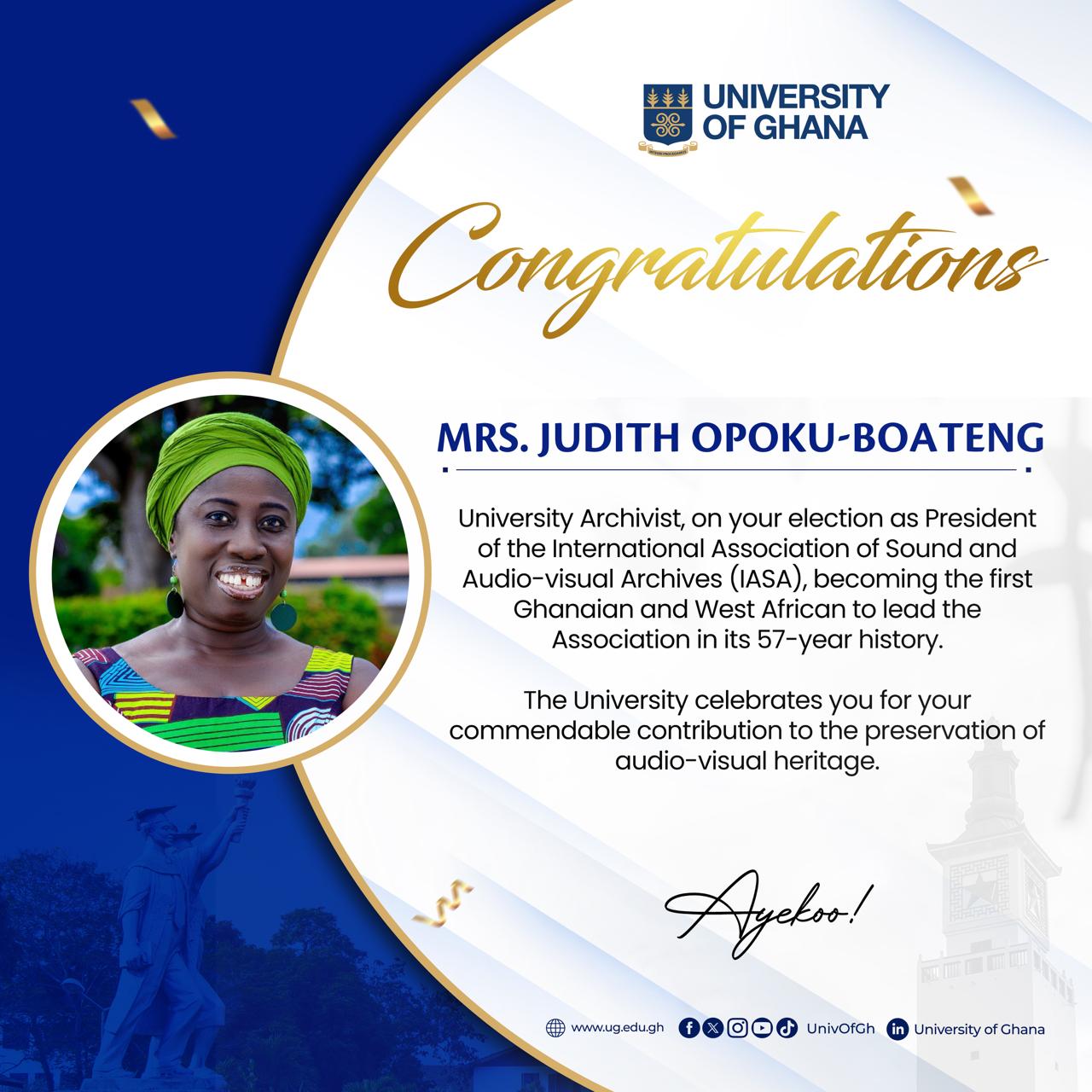
Ghanaian archivist Mrs. Judith Opoku-Boateng has been elected President of the International Association of Sound and Audiovisual Archives (IASA), the global authority on the preservation of sound and moving image heritage. She is the first Ghanaian and the first West African to lead the Association in its 57-year history.
Mrs Opoku-Boateng, University Archivist and Head of the University of Ghana Archives, will serve a three-year term as President of IASA from 2026 to 2029. In this role, she will lead an international professional association that brings together sound and audiovisual archives, national libraries, broadcasters, universities, research institutions, and professionals working to preserve and provide access to the world’s sound and audiovisual heritage across more than 70 countries.
Since its foundation in Amsterdam in 1969, IASA has set the international standards for the care of recorded sound and audiovisual collections. Its technical guidelines, among them IASA-TC-03 on The Safeguarding of Audiovisual Heritagep: Ethics, Principles and Preservation Strategy; IASA TC-04 on Guidelines on the Production and Preservation of Digital Audio Objects; IASA-TC-04 on Handling and Storage of Audio and Video Carriers; IASA-TC 06 on Guidelines for the Preservation of Video Recordings. The Association also works with UNESCO on audiovisual heritage and is a member of the Coordinating Council of Audiovisual Archives Associations (CCAAA)
For more than five decades, the IASA presidency has gone to archivists from Europe, North America, Australia and South Africa. The election of Mrs. Opoku-Boateng brings the top office in the field to Ghana and West Africa for the first time.
Mrs. Opoku-Boateng won the presidency ahead of two other candidates, IASA members cast their votes electronically between June and September 2026. The Association has since announced the official results at its General Assembly at its 2026 Conference in Vilnius, Lithuana.
Her election comes at a time of renewed global debate on African heritage held in archives abroad. Large parts of the recorded music, oral history and film of Africa sit in collections in Europe and North America and the return and digitisation of this material is now a major concern for archivists, governments and communities. Mrs. Opoku-Boateng has made the restitution of African audiovisual heritage a central part of her work.
The presidency follows many years of service to IASA. From 2020 to 2023, Mrs. Opoku-Boateng served on the IASA Executive Board as Vice-President for Communication, the first Ghanaian to sit on the Board. She chaired the IASA Diversity Task Force from 2017 to 2019 and serves as IASA Ambassador for Ghana and West Africa. She is also a member of the Diversity, Equity and Inclusion Committee, the Research Archives Committee and the Ambassadors Committee. In 2018, she brought the 49th IASA Annual Conference to Accra.
In her statement to members, she pledged to review the committee structure of IASA and to set up new bodies, among them a Youth and Emerging Professionals Network and a Digital Preservation and Innovation Committee. She described her goal as an IASA where “knowledge flows across borders.”
In reaction to the news, Mrs. Opoku-Boateng said, “I am deeply honoured by the confidence placed in me by the IASA community. I see this election not only as a personal milestone, but also as an opportunity to contribute to the global sound and audiovisual archiving community and to bring greater visibility to the important work being done in Africa and the rest of the world."
She added, "I look forward to working with the Executive Board, our members, and partner organisations around the world to build on IASA’s strong foundations, strengthen collaboration, broaden participation, and support the next generation of audiovisual archivists. I am also proud to serve in this role while leading the University of Ghana Archives System, and I hope this achievement will inspire other African archival professionals to take up leadership roles in the international community.”
Mrs. Opoku-Boateng has more than 30 years of experience in audiovisual heritage documentation and preservation. Before she was appointed University Archivist, she was Senior Archivist at the J. H. Kwabena Nketia Archives of the Institute of African Studies, University of Ghana. There, she led work on audiovisual, photographic and paper heritage, among them the MAARA (Making African Academic Resources Accessible) audio digitisation project with New York University; The Heritage Photo Lab Project – in collaboration with the Goethe-Institut and Institut Français, including several community Archiving Projects. Her research covers oral history, community memory, archival activism and the restitution of African audiovisual heritage. Her numerous Publications in Peer Review Journals are a testament to some of the work she has done in the field.
She studied Sociology and Archival Studies at the University of Ghana, where she earned both her bachelor's and master's degrees. She also holds technical certificates in Audiovisual Heritage Preservation and is currently pursuing a PhD at a European university..
Her election is a milestone for Ghana and for Africa. It places an African archivist at the head of the foremost international body in the field and gives the continent a stronger voice in global decisions on the preservation and return of its audiovisual heritage.
The University of Ghana congratulates Mrs. Opoku-Boateng on this historic achievement and wishes her a successful tenure.