Mensah Sarbah Hall Launches Risk Register to Enhance Campus Safety and Institutional Governance

Mensah Sarbah Hall has introduced a Risk Register, becoming the first hall of residence at the University of Ghana to adopt the framework, as part of efforts to improve safety management, institutional coordination and student welfare systems.
This initiative is aimed at supporting more structured identification, assessment and management of risks across key operational areas within the hall, including infrastructure, financial administration, governance processes and student welfare.
Speaking at the launch, the Hall Master, Prof. Roger Atinga, explained that the initiative was informed by an internal audit report, which raised issues extending beyond financial compliance to broader aspects of hall governance.

He indicated that the Risk Register covers facility oversight and financial accountability, student governance and welfare considerations affecting students, staff and fellows. Prof. Atinga emphasised that the exercise is a shared institutional responsibility that requires active participation from all stakeholders within the hall community.
He added that capacity-building sessions for staff, fellows and vendors would be organised following the launch to support effective implementation and to embed a more structured risk management culture within the hall.
Delivering the keynote address, the Deputy Director of the Internal Audit Directorate in charge of Risk Management, Prof. Samuel N. Y. Simpson, commended Mensah Sarbah Hall for taking steps to operationalise audit recommendations. He observed that while risk issues are frequently identified in audit reports across the University, implementation has often been limited.
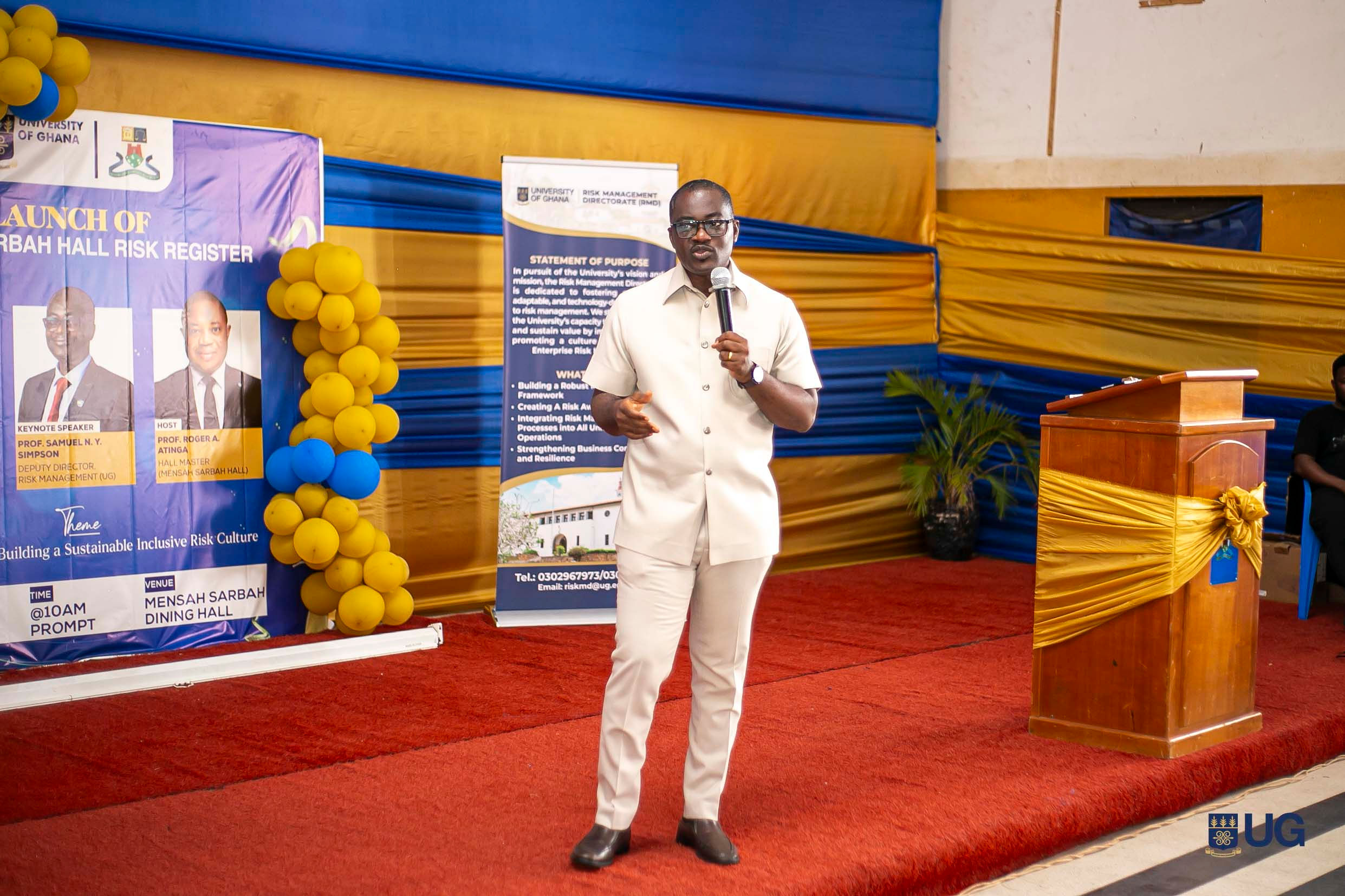
He outlined key concepts in risk management and introduced the TARA framework, Transfer, Avoid, Reduce and Accept, as a practical approach for managing residual risks. He further stressed that the Risk Register should be treated as a dynamic tool requiring regular review, with clear assignment of responsibility for identified risks.
The Dean of Student Affairs, Prof. Rosina Kyerematen, noted that the Risk Register addresses a broad range of areas, including health and safety, infrastructure, fire preparedness, governance and student welfare. She explained that the initiative is intended to support foresight, preparedness and shared accountability rather than fault-finding.

She also reflected on past inter-hall tensions and encouraged the use of structured engagements such as sports and social activities to promote stronger relations among halls of residence.
“Whether from Commonwealth or Sarbah, what matters most is that we are all part of the University of Ghana community,” she said.
The introduction of the Risk Register aligns with the University’s broader agenda of strengthening governance systems and improving residential safety and coordination. Hall authorities expressed optimism that the initiative will serve as a reference point for other halls of residence across the University.