
How Shadowing a World Bank Review Mission Deepened Our Understanding of African Economic Integration
By Abass I. Abdul Fatawu and Klenam Dziewornu
Department of Economics, University of Ghana
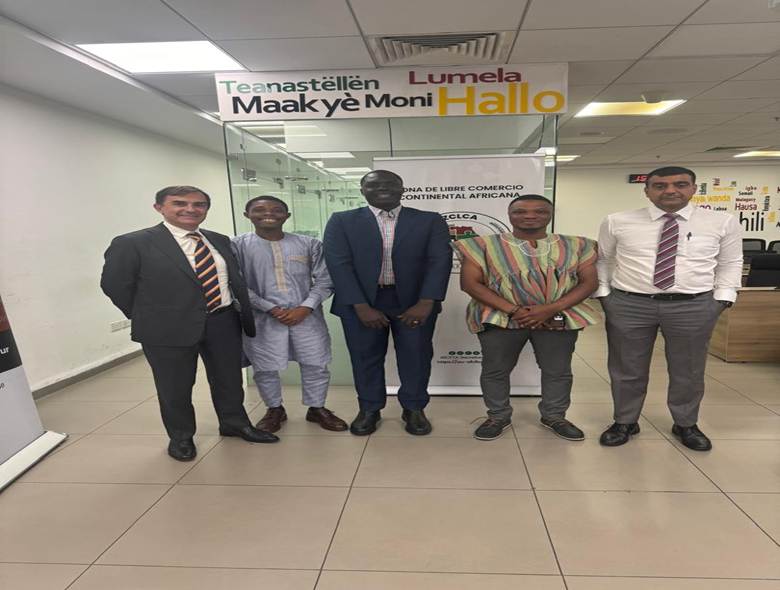
World Bank Mission: Group photograph with members of the World Bank team
As economics students, much of our understanding of regional integration and trade policy comes from academic literature and policy reports. While these sources provide valuable insights, they often cannot fully capture the realities of policy implementation.
Our participation in a World Bank review mission at the AfCFTA Secretariat in Accra provided a rare opportunity to observe those realities firsthand. This experience grew out of a growing engagement between the World Bank and the Department of Economics at the University of Ghana to create practical learning opportunities for graduate students. Through a student shadowing programme, we joined discussions between World Bank officials and AfCFTA Secretariat staff reviewing progress under the BIASHARA Project, an initiative supporting the implementation of the AfCFTA Agreement and advancing regional economic integration across Africa.
One of the most important lessons from the experience was how complex it is to translate continental agreements into practical outcomes. Discussions focused on digital trade, trade in services, investment facilitation, dispute settlement mechanisms, and project sustainability. Beyond technical progress, participants highlighted the institutional coordination and continuous engagement required to achieve meaningful results.
The experience reshaped how we think about policy implementation. Concepts that previously existed only in textbooks became tangible through direct observation of stakeholder consultations, monitoring processes, and evidence-based decision-making. We gained a deeper appreciation of the fact that effective policies depend not only on sound design but also on strong institutions and collaborative implementation.
Another key takeaway was the growing importance of digital systems in supporting trade integration. Conversations emphasised the need for stronger knowledge management, improved monitoring frameworks, and better information-sharing mechanisms across AfCFTA structures.
These discussions revealed important opportunities for future research and innovation.

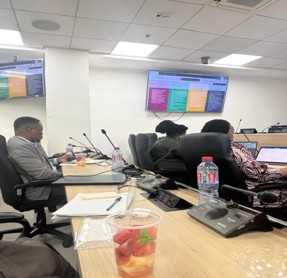
Beyond the meetings, the mission provided valuable interactions with policymakers and development practitioners working on Africa's integration agenda. These engagements offered practical perspectives that complemented academic learning and demonstrated the value of connecting research with policymaking.
Reflecting on the experience, we are convinced that closer collaboration between universities and development institutions can help produce research that is both rigorous and policy-relevant. The shadowing programme reminded us that some of the most valuable lessons in economics are learned where evidence is translated into action.
Biography

Brief Bio: Abass I. Abdul-Fatawu is a Development Economics PhD Candidate (Second Year) at the Department of Economics, University of Ghana, and a Graduate Research Assistant with the Bank of Ghana Chair in Economics and Finance, University of Ghana. He also serves as a Personal Research Assistant to Prof. Augustin K. Fosu, a Professor of Economics at the University of Ghana's ISSER. His research interests span development economics, international trade, climate vulnerability, public finance and governance. He has over 7 years of experience in economic research, impact evaluation, survey design and policy analysis. He has previously worked with the International Growth Centre (IGC), Associates for Change and the Mastercard Foundation - Young Africa Works Initiative.

Klenam Dziewornu-Norvor is a 2nd year M.Phil. Economics candidate at the University of Ghana, specialising in International Economics. His research focuses on mobile money and the profitability of informal firms in Sub-Saharan Africa, with evidence from Ghana, Tanzania, and the Democratic Republic of Congo. He currently supports the African Trade Union Network for Economic Transformation (ATUNET) at ITUC-Africa, where his work covers debt, trade, fiscal policy, and regional economic transformation. He has also worked with GIZ Ghana, GIZ’s Programme Support to the AfCFTA, ACET, and other development organisations on trade policy, cross-border trade, and private sector development.