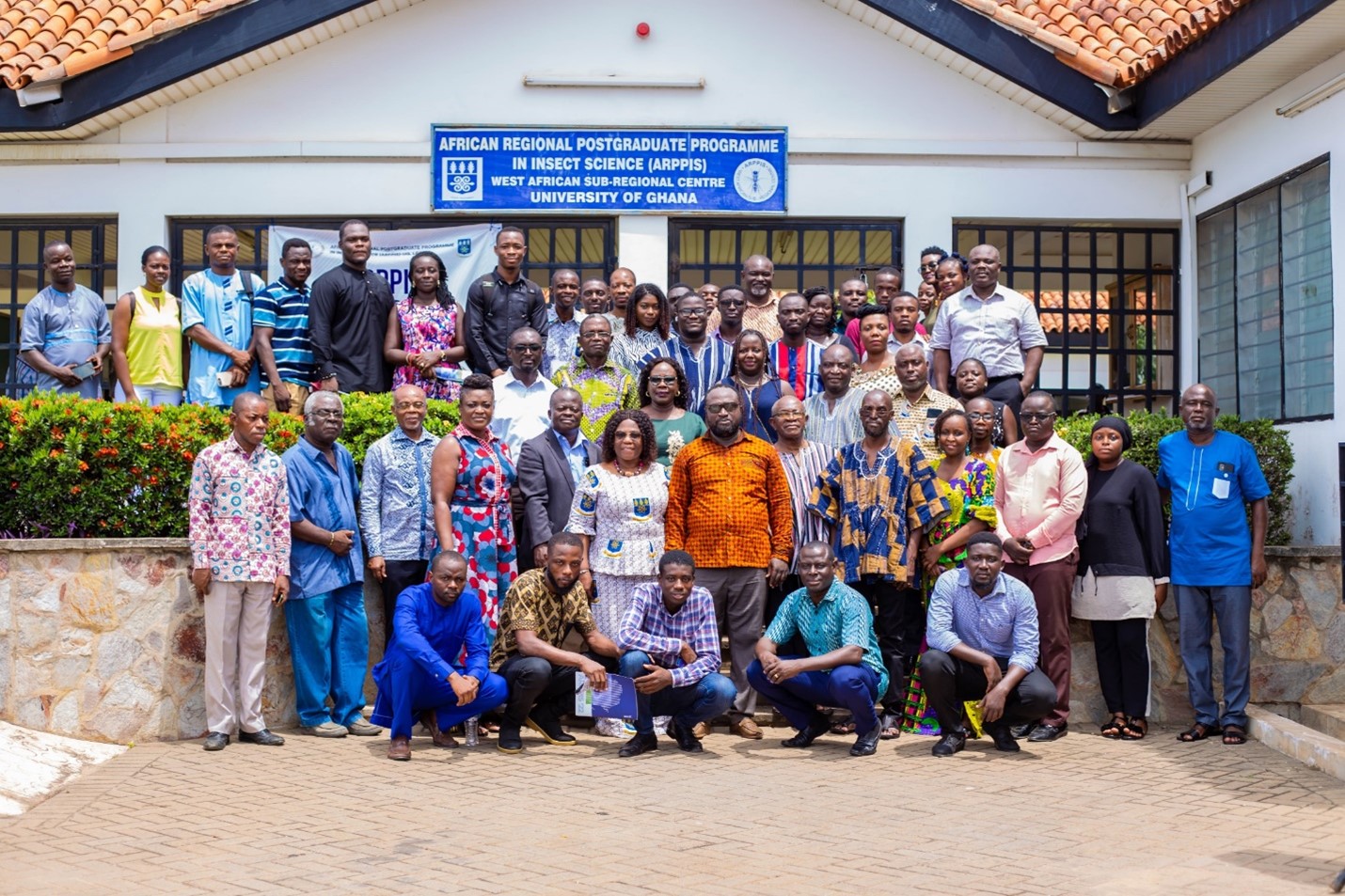
The African Regional Postgraduate Programme in Insect Science (ARRPIS) - Sub-Regional Centre for West Africa was established in 1991 with approval from the ARPPIS Academic Board-ICIPE (Nairobi) and the Academic Board University of Ghana, Legon, Accra. ARPPIS is a collaborative network project involving, ICIPE Kenya, some African universities as well as donor agencies for the training of Insect Scientists (capacity building) to solve Africa’s numerous insect pest problems. The ARPPIS subregional Centre, University of Ghana, is the only operational Centre among the 3 established Sub-regional Centres in Africa. The ARPPIS Subregional Centre, University of Ghana, currently referred to as the Insect Science Programme, offers an international programme leading to the award of a Master of Philosophy (MPhil) degree in Entomology, and recently Doctor of Philosophy (PhD) degree in Entomology. The focus of the programme is for the training of Entomologists from the West African Sub-Region, but students are admitted across Africa.
The programme is administered as a joint inter-school course between the School of Agriculture and the School of Biological Sciences, with Crop Science and Animal Biology and Conservation Science (DABCS) as the main collaborating Departments. Scientists from other Departments and Institutes of the University of Ghana also participate in teaching and supervision of students. These include the Department of Biochemistry, Cell & Molecular Biology (BCMB), School of Public Health, the Noguchi Memorial Institute for Medical Research (NMIMR), Institute for Applied Science & Technology (IAST) and the three Agricultural Research Centres of the School of Agriculture (SIREC, FOHCREC and LIPREC). Since its inception in 1991, A total of 315 graduate students (284 MPhils and 31 PhDs) have been enrolled. The programme draws its strengths from several sources including a teaching and research faculty of some 22 full and part time professional entomologists, chemical ecologists, toxicologists, geneticists, molecular biologists, agronomists and animal scientists as well as some 20 other entomologists and researchers from partner institutions and other national institutes and agencies, and a full range of laboratory and field equipment for teaching and research.