





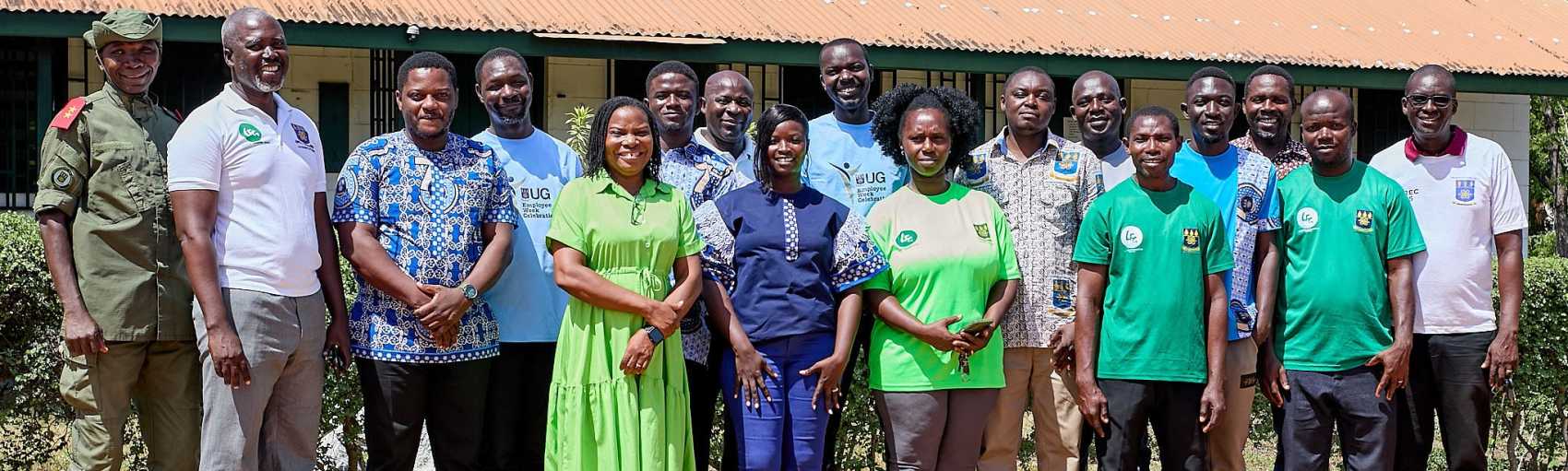


Head of Centre's Message
I welcome you to the Livestock and Poultry Research Centre- (LIPREC).
As said by the renowned management consultant Peter Drucker, “Nothing measured, nothing managed”. So, at LIPREC, we do the measurements or research, come out with results or findings and pass on the technology to our farmers for effective management of their enterprises, to improve the performance of their animals, and produce healthy livestock and poultry products.
The Livestock and Poultry Research Centre (LIPREC) was established in 1953 and is approximately 15 km from the main University of Ghana campus. It occupies an area of 300 hectares and focuses on livestock and poultry research and production (cattle, sheep, goats, pigs, poultry, guinea fouls, rabbits, grasscutter etc.)
The vision of LIPREC is to be a Centre of excellence for research and training of students, agricultural professionals and farmers to solve the problems of livestock and poultry production.
The Mission is to provide an excellent environment for the conduct of research into livestock and poultry for the advancement of Ghana’s agriculture and to offer practical training to students, agricultural professionals and farmers for cost-effective and ecologically sustainable livestock and poultry production.
The Objectives of LIPREC are to:
- Carry out research into all aspects of domestic livestock and poultry production.
- Provide livestock management and improvement information to farmers and stakeholders.
- Provide facilities for student instruction.
- Establish close collaboration with national and international institutions, NGO’S and industries with similar objectives.
- Develop efficient research information transfer services including extension and consultancy.
LIPREC is a huge resource for practical training of Staff, Graduate and Undergraduate students of the School of Agriculture in all aspects of animal production and research. We offer short courses for relevant stakeholders. We are in collaboration with the Leventis Foundation Farmers Training Programme in training young and would-be farmers – a direct and relevant extension service.
OUR RESEARCH FOCUS
The Centre’s research focus is to improve the performance of both local/exotic breeds of livestock/poultry through improved nutrition and health.
Research at LIPREC is categorized into six broad themes namely;
- Animal improvement and production systems
- Animal nutrition and forage science
- Animal health
- Animal traction
- Livestock produce processing
- Agribusiness and systems innovation
This involves research in areas such as;
- Strategies for improving the utilization of rangelands, cereal crop residues and non-conventional feed resources by ruminant livestock
- Strategies to reduce enteric methane production using indigenous feed options
- Harvest management and preservation of forages
- Development of sustainable feed options for monogastrics
- Development of genetic markers for native livestock/poultry species
- Transmission and control of zoonotic diseases along the value chain
SOME INNOVATIONS AND MILESTONES
The Centre is known for the development of the Nungua Black Head (NBH) breed of sheep. It is also known for the research into and use of the Urea-Molasses Block as a supplement for ruminant livestock in the dry season.
In 2003, the Centre again was in the news for the development of the single axle donkey tipping cart for farming and urban refuse collection. The loading capacity of the cart is 500kg or 700kg when used by a single and paired donkeys respectively. It was appropriately named University of Ghana, Agricultural Research Station (UGARS) tipping cart.
In recent times, the Centre has produced newer dry season feeding strategies for ruminant livestock. This is mainly through the production of pelleted feed. We have the Pelletized Protein leaf meal as supplementary feed for small ruminants. This meal is prepared from the use of leaves of browse species that maintain a high crude protein content all year round (15-25%). The second is the Pelletized Fortified leaf meal. In addition to the high crude protein content, this second meal is fortified with minerals such as, calcium, phosphorus, iodine, sulphur, zinc, copper and cobalt.
The Centre has developed ways to propagate Super Napier Grass (SNG), a hybrid fodder plant produced from Pearl Millet and Elephant grass. The propagation methods employing the right cutting severity and harvest frequency yields total dry biomass of about 4.3, 8.5 and 11.4 t/Ha and 14.3, 11.8 and 9.6% of Crude protein content in 45,60 and 75 days after planting respectively.
The Centre has a dairy unit known for the production of Varsity yoghurt. The unit has facilities to process milk into yoghurt and cheese and for training. In December, 2017, the Centre entered into partnership with the Dairy Research Improvement and Innovation Consortium (DRIInC) to upscale its activities. This partnership led to the procurement and installation of a semi-automated dairy machine that can process about 1000 litres of milk into yoghurt per day. It has also led to the development of a new product (stirred or cup yoghurt).
The Centre is really fulfilling its mandate in training students, farmers and agricultural professionals. Each year, about 1500 people visiting our Centre for educational purposes. Some from Universities outside Ghana.
We invite you to LIPREC for a tour of our facilities, for research collaboration and for training.
Study With Us
News


