
Dr. Raphael A. Ayizanga
Dr. Raphael A. Ayizanga is currently a Senior Lecturer at the Department of Animal Science of the University of Ghana, Legon. He obtained a Diploma in General Agriculture (with Distinction), a BSc in Agriculture (First Class Honours) and an MPhil in Animal Breeding, all from the University of Ghana, Legon and a PhD in Animal Breeding and Genetics from the Kwame Nkrumah University of Science and Technology, Kumasi, Ghana.
Having grown up in an agricultural setting in northern Ghana and being a trained agriculturist, he has considerable knowledgeable in both theoretical and practical agriculture. With a keen interest in improving animal production, particularly poultry and pig production in Ghana, Dr. Ayizanga has taught several courses in animal production and related courses since 2010. Besides, he is a practicing animal scientist, with experience in poultry and pig production. He has helped numerous farmers to improve on their animal production ventures and has published an easy to read reference material entitled A farmer’s guide to pig production in Ghana and currently working on another book for poultry farmers.
Dr. Raphael A. Ayizanga has a lot of experience in dealing with farmers. He was part of the team of scientists on the Feed the Future funded International Institute for Tropical Agriculture (IIITA) Africa Research in Sustainable Intensification for Next Generation (Africa RISING) project in northern Ghana in 2014 – 2016 and currently serving as a Project Assistant on the Tropical Poultry Genetics Solution (TPGS) project, a project sponsored by the International Livestock Research Institute (ILRI), where some strains of chickens are being tested in farmer settings in selected communities in southern Ghana.
DR. GAMALIEL SETH TAWIAH LARTEY JNR
Having obtained his Bachelor of Science in Agriculture from the University for Development Studies, Master of Philosophy in Animal Science (Major in Meat Science) from the University of Ghana, Legon and his Ph.D in Animal Science (Major in Meat Science) from the University of Cape Coast - Ghana, Dr. Gamaliel Seth Tawiah Lartey Jnr. is a Meat Science Lecturer in the Animal Science Department of the University of Ghana, Legon. His research interests include Meat Processing, Impact of feed on carcass characteristics of meat animals and organoleptic properties of their meat, meat product formulation, microbial quality of meat in storage and plant-base ingredients as agents for meat shelf-life extension in place of synthetic ingredients. He is a member of the Ghana Society of Animal Production, a professional body in Ghana, comprising of all stakeholders and player in the Agricultural sector.
Dr. Benjamin Adjei Mensah
Dr.Benjamin Adjei Mensah (PhD)
Dr. Benjamin Adjei Mensah
Contact email: badjei-mensah@ug.edu.gh
Web of Science Researcher ID: AEM-9259-2022
Scopus Researcher ID: 57912684800
ORCID ID: https://orcid.org/0000-0002-5649-1924
ResearchGate:
https://www.researchgate.net/profile/Benjamin-Adjei-Mensah-2
How I got along with studies with the help of my lecturers and a couple of friends
1. The Mentorship of Lecturers
In a department led by experts like Professor Kayang, the relationship between a student and a lecturer often goes beyond the classroom.
Guidance in the Lab: Having lecturers who are willing to spend extra time explaining the nuances of proximate analysis (Crude Protein, Ether Extracts, etc.) or troubleshooting a research thesis is invaluable.
Professional Standards: They don't just teach the science; they model the ethics and precision required to be a "Principal" level professional.
2. The Strength of Peer Support
Studies in Animal Science can be physically and mentally demanding, from field work at LIPREC to long hours in the nutrition labs.
Collaborative Learning: Having a "couple of friends" to review data with or debate agricultural policy helps solidify complex concepts.
Emotional Resilience: As seen in your graduation photos, that sense of shared achievement creates a bond that often turns classmates into lifelong professional colleagues.
March 15, 2023
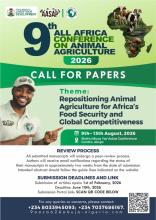
All Africa Conference on Animal Agriculture (AACAA).
9th All Africa Conference on Animal Agriculture (AACAA).
The conference is a significant event for researchers and professionals in the livestock sector. Here are the key details:
Event Overview
Theme: "Repositioning Animal Agriculture for Africa’s Food Security and Global Competitiveness."
Date: 9th – 13th August, 2026.
Location: Shehu Musa Yar’Adua Conference Centre, Abuja, Nigeria.
MOLECULAR GENETICS LAB
Our Animal Science Molecular Genetics Lab focuses on understanding the genetic makeup of livestock to improve productivity, health, and sustainability. Using modern molecular tools such as DNA sequencing, gene expression analysis, and genotyping, we investigate traits related to growth, disease resistance, reproduction, and adaptation to environmental stress. The lab also supports research in biotechnology and breeding programs, training students and researchers in cutting-edge techniques while contributing practical solutions to challenges in animal agriculture, particularly in developing regions
NUTRITION LAB
Our Animal Nutrition Laboratory specializes in the evaluation of feed quality to support efficient and sustainable livestock production. The lab focuses primarily on proximate analysis, determining moisture, crude protein, fat, ash, and energy content, as well as fibre fraction estimation, including neutral detergent fibre (NDF) and acid detergent fibre (ADF). These analyses are essential for assessing the nutritional value and digestibility of feed resources, particularly local and alternative feed ingredients. The laboratory also provides hands-on training for students and researchers, equipping them with practical skills in feed analysis and ration formulation
• Animal Nutrition Laboratory
The Animal Nutrition Laboratory is a fundamental facility within the Department of Animal Science, dedicated to the chemical analysis and evaluation of feed materials. It provides the essential data required to formulate balanced diets that optimize livestock growth, reproduction, and health.
Core Capabilities: Proximate Analysis
The laboratory specializes in Proximate Analysis, a series of analytical procedures used to determine the nutritional components of feed samples. This includes:
Dry Matter (DM): Determining the moisture content to calculate the actual nutrient density.
Crude Protein (CP): Measuring nitrogen content to estimate the protein available for muscle development and milk production.
Ether Extract (EE): Assessing the crude fat content, which serves as a concentrated energy source.
Crude Fiber (CF): Measuring the structural carbohydrates, essential for ruminant digestion and gut health.
Ash Content: Determining the total mineral content by burning off organic matter.
Research and Industry Services
Beyond student training, the lab plays a critical role in Ghana's agricultural economy:
Feed Quality Control: Assisting local farmers and commercial feed millers in verifying the quality of their ingredients (such as maize, soy meal, or fishmeal).
Alternative Feed Resources: Researching the nutritional value of non-conventional feedstuffs, such as agro-industrial by-products, to reduce production costs for smallholder farmers.
Metabolizable Energy Estimation: Calculating the energy value of diets to ensure animals meet their physiological requirements without waste.
Supporting Academic Advancement
For MPhil and PhD candidates, the Animal Nutrition Laboratory is where theoretical formulas are tested. Students gain hands-on experience with specialized equipment like Kjeldahl distillers for protein analysis and Soxhlet extractors for fat determination. This practical expertise is vital for those moving into roles as nutritionists, farm managers, or research scientists.