Office of the Principal

Welcome to the University of Ghana Accra City Campus (UGACC) — Inspiring Minds, Transforming Futures


Located at the heart of Ghana’s bustling capital, UGACC is a dynamic centre of excellence committed to advancing knowledge, innovation, and leadership for national and continental transformation. As an integral part of the University of Ghana, we uphold the University of Ghana’s vision of achieving “global impact through innovative research, teaching and learning, using a technology-driven and people-centred approach” by providing accessible, high-quality education and an exceptional student experience.

Our vibrant campus community brings together talented students, distinguished faculty, and dedicated staff to create an environment where ideas flourish and potential is realized. Whether you are a prospective student, a partner institution, or a member of our extended community, we invite you to join us in shaping the future of Ghana and Africa through knowledge, creativity, and service.

At UGACC, we are proud to offer an educational experience that blends academic rigor with real-world relevance. With modern facilities, a supportive learning environment, and a central location that connects students to the heartbeat of Accra’s economic and cultural life, UGACC provides unparalleled opportunities for growth and discovery.

We invite you to explore our programmes in the Arts, Business Administration, and the Social Sciences, and to become part of a vibrant community dedicated to excellence and impact. Join us — and let’s shape the future together.


UGACC

Inspiring Minds, Transforming Futures
Image
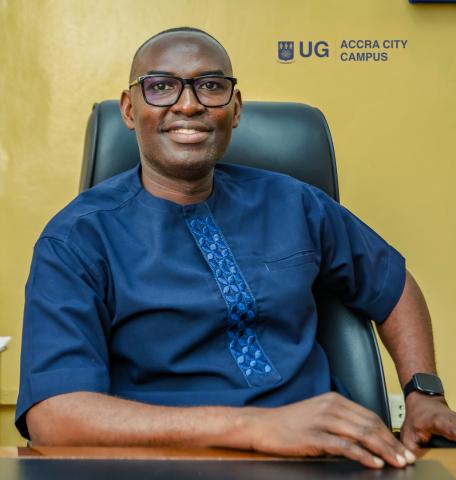
Professor Clement Kwamina Insaidoo Appah

Mission

We will create a thriving environment that places the Accra City Campus at the forefront of excellence in cross-disciplinary studies and cutting-edge research relevant to both national and global developmental needs.

Core Values

Our core values are:

Integrity; Respect; Loyalty; Commitment; Innovation

History of Accra City Campus

The now University of Ghana Accra City Campus was established in the 1963/1964 academic year as the Accra Workers' College. This academic unit was reborn in the 2003/2004 academic year as the University of Ghana Accra City Campus.

The Accra City Campus was supposed to function based on the logic of meeting the educational needs of workers in the Central Business District (CBD). This follows from the vision of the first president, Kwame Nkrumah, to transform the Ghanaian worker's soft skills and knowledge base using the Accra Workers College. In this regard, the Convention Peoples Party building was given out to meet this critical function. Over time, this objective has been achieved with few workers in Ghana today occupying positions that require degrees not having these. The current generation of job seekers is dominated by degree holders substantiating the claim that the backlog of non-degree holders employed in the 1980s has been cleared. The logic of making higher education accessible to workers in the CBD is no longer tenable since patrons of programs of the ACC come from all regions of the country. The campus offers courses from the Colleges of Humanities and Education leading to the award of Bachelor of Arts and Bachelor of Science degrees.

In 2014 when the collegiate system was introduced, the Accra City Campus (ACC) was temporarily placed under the College of Humanities. The UGACC is currently a semi-autonomous campus unit of the University of Ghana.

Over the years, there has been a progressive increase in relatively younger students from the various Senior High Schools. The latter category of students currently dominates the patrons of the ACC programmes. The campus admits a large number of students, and in the 2020/21 academic year, the total number of students was 7300, out of which over 2400 were new Level 100 students. This has increased to 10,300 students in the 2022/23 academic year out of which 2529 are level 100 students. The necessary progressive increase in the student numbers has brought in its wake an increase in the pressure on academic facilities.